
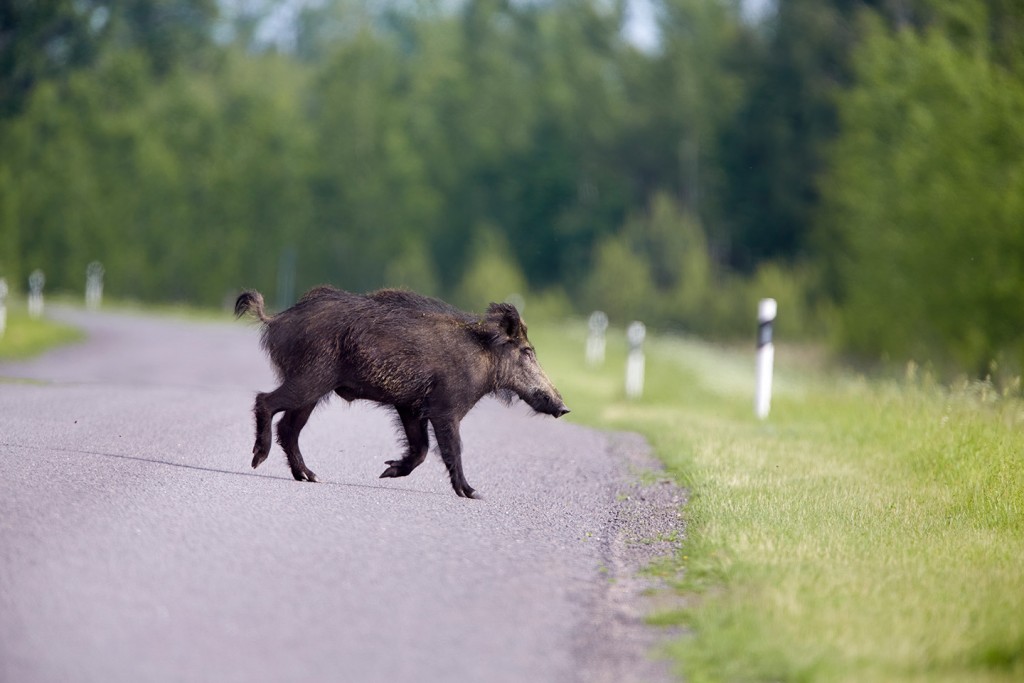
Animal collisions increase especially in autumn, when the days become shorter and darker, and peak traffic hours fall in the twilight period, both in the morning and in the evening. “The number of wild animals our roadside cameras capture is increasing with each passing day and unfortunately there are also more animal-related risky traffic situations and accidents,” said Villu Lükk, head of environmental management at the Transport Administration.
In autumn, hunters start joint hunts for big game, mainly on weekends, which drives wild animals to move and they may end up on the roads more often.
In many places across Estonia, animal crossings have been created on fenced road sections, which are equipped with warning signs. The Transport Administration also posted the notice “Beware of wild animals” on road information displays after dark.
On the four-lane Kose-Võõbu road section, the first big game detection system in Estonia warns drivers of wild animals. In the dark, the information displays installed display a warning “Sign flashing = animal on the road” ahead of animal crossings. If the big game detection system has activated the alarm and the speed limit signs are flashing, you must reduce your speed to at least the established 70 kilometres per hour and be ready to stop and turn on the hazard lights if an animal is on the road or about to cross the road.
It is impossible to react to a moose on the road at a speed of 90 km/h with dipped-beam. The driving beam reaches a distance of up to 50 metres and the vehicle would cover this distance in two seconds driving at 90 km/h. It takes a second for the driver to react and the remaining one second is not enough to prevent an accident.
“Wild animals have their trodden paths that they do not willingly change,” said Lükk. “Therefore, you must be especially careful in the area of the “Wild animals on the way!” road sign, follow the speed limits and, if necessary, slow down. A wild animal always has the right of way.”
Approximately 6000 traffic accidents involving wild animals are registered on Estonian national roads each year. Approximately 20-30 people are injured in these accidents annually. In recent years, the problem has increased, because there are more vehicles on Estonian roads.
Advice from the Transport Administration to reduce the risk of collision:
- Concentrate while driving! When driving, do not use your phone or other smart devices. Pay attention to the highway and its surroundings.
- Choose a safe speed! Choose a driving speed appropriate to the weather and road conditions. Animals may also be on the move in bad weather, especially in a drizzle or light blizzard.
- Keep an eye out for the traffic sign “Wild animals on the road”! Be especially attentive in the area of this sign, because animals cross the road there more often. It is also worth staying alert in areas between groves and near fields.
- Be alert at dusk, especially before sunrise and after sunset, when wild animals are naturally more active. If you see a pair of eyes glowing in the dark, slow down and stop, if necessary, and turn on your hazard lights.
- A wild animal is unpredictable! If an animal is on the road or on the side of the road, slow down and turn on the hazard lights. Do not brake abruptly or lose control of the vehicle. A second or third may follow the first animal. An animal that has crossed the road can also decide to turn back at the last moment. Do not sound the horn as this will startle the animal and make it move unpredictably.
- Do not tailgate! The distance from the vehicle in front of you must be sufficient to avoid hitting it should the driver brake abruptly because of an animal on the road.
- Car headlights should always be clean, especially when driving in the dark.
- Remember that in the dark the field of view is significantly limited by the lights of the oncoming car! If necessary, reduce speed.
In the event of an accident:
- Stop and turn on your hazard lights and position lights and put on a safety vest when exiting the vehicle.
- If there are any human victims, call 112.
- If a big game animal has been killed or injured, report it to the hotline 1247.
- Before calling, try to identify the species and determine the exact location of the event using the Waze application on your smartphone, for example. A description of objects characteristic of the location, for example a kilometre post or a bus stop, is also helpful.
- The more precise information you provide, the easier and faster hunters can react in a situation where a dead game needs to be quickly removed from the road.
- If the animal moved off the road by itself but is likely to be injured, report the incident to 1247 as well, giving as accurate a description of the location as possible.
More information: https://transpordiamet.ee/ulukid

